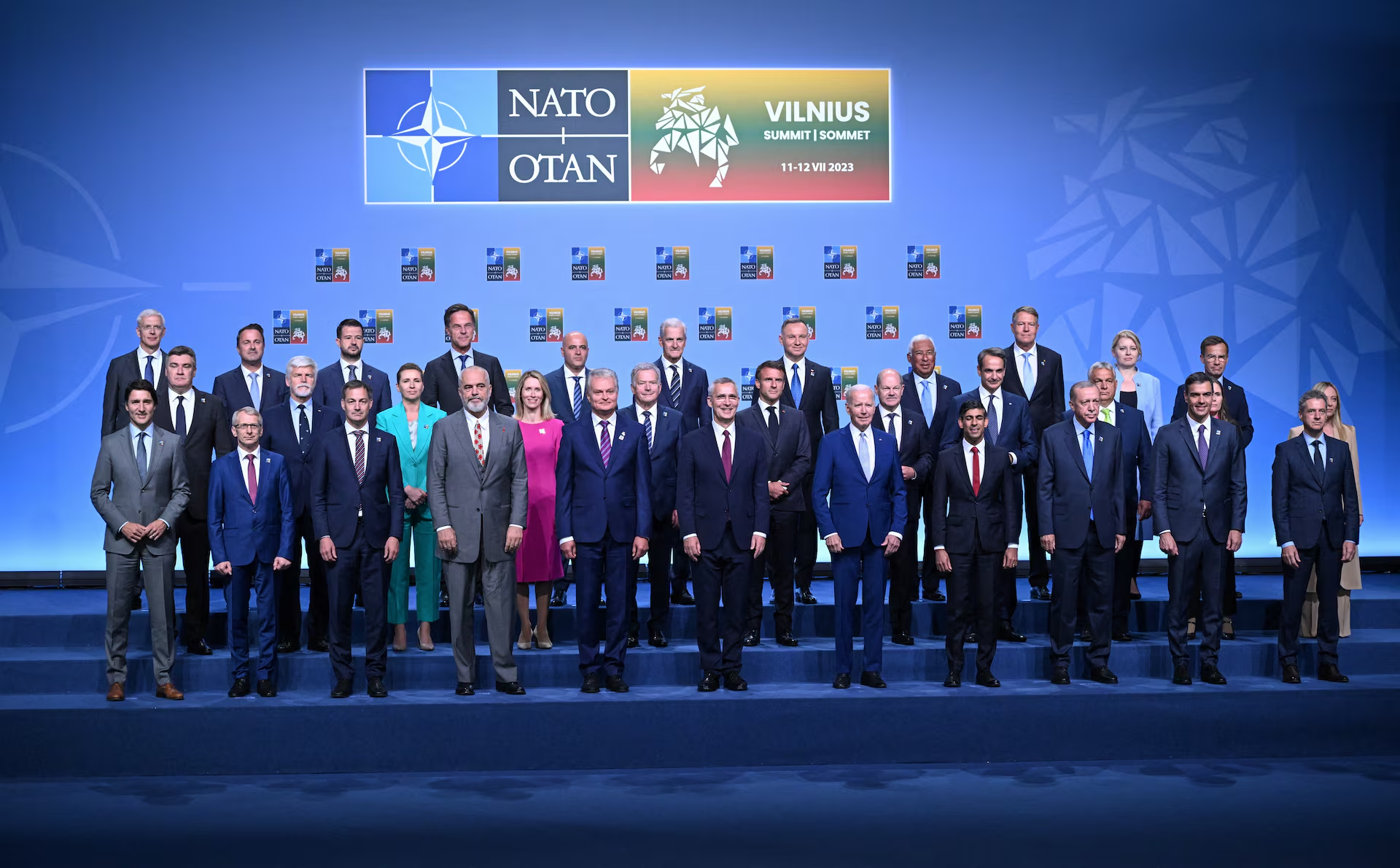
Recent foreign policy remarks by former U.S. president Donald Trump have sparked renewed controversy on the international stage, provoking criticism from political leaders, diplomats, and commentators in key allied countries — notably the United Kingdom and Canada. The backlash highlights lingering unease among traditional U.S. allies over Trump’s approach to diplomacy, alliances, and global security as he continues to play a dominant role in American politics.
Trump’s comments, delivered during a series of public appearances and interviews, revisited long-standing critiques of NATO, questioned the value of certain security commitments, and portrayed several allied governments as unfair beneficiaries of U.S. military protection. While Trump has made similar arguments in the past, the renewed attention comes amid heightened global instability, amplifying concerns about the implications of his rhetoric.
Remarks That Rekindled Tensions
In his recent statements, Trump argued that U.S. allies had “taken advantage” of American defense spending and suggested that Washington should reconsider its commitments unless partners substantially increased their financial contributions. He also criticized past U.S. military engagements and hinted that alliance obligations should be conditional rather than automatic.
Although Trump did not single out specific countries in every instance, his language was widely interpreted as referencing NATO members, including Britain and Canada, both of which have been long-standing contributors to alliance operations. His remarks quickly circulated through international media, prompting official and unofficial responses across the Atlantic.
Foreign policy analysts noted that while skepticism toward alliances resonates with parts of the U.S. electorate, such messaging often triggers alarm among allies who rely on the predictability of U.S. commitments.
Reaction in the United Kingdom
In the UK, Trump’s comments were met with a mixture of frustration and concern. Senior British politicians emphasized that the transatlantic alliance remains central to European security, particularly at a time of heightened geopolitical tension.
Members of Parliament from both major parties publicly defended Britain’s military contributions, noting that the UK is one of the few NATO countries that consistently meets or exceeds defense spending targets. They also pointed to Britain’s long history of fighting alongside U.S. forces in conflicts ranging from Afghanistan to counter-terrorism operations.
Former diplomats warned that rhetoric questioning alliance solidarity could embolden adversaries and weaken deterrence. British media coverage framed Trump’s remarks as a reminder of the uncertainty that characterized U.S.–UK relations during his presidency, when traditional diplomatic norms were frequently challenged.
Canada Pushes Back on Alliance Criticism
Canadian officials also responded forcefully, rejecting any implication that Canada had failed to shoulder its share of collective defense responsibilities. Government representatives highlighted Canada’s role in NATO missions, peacekeeping operations, and recent security initiatives in Eastern Europe.
In Ottawa, lawmakers stressed that Canada’s relationship with the United States extends beyond defense spending, encompassing intelligence sharing, trade, and joint border security — areas where cooperation remains deep and mutually beneficial.
Canadian commentators noted that Trump’s remarks revived concerns from his earlier presidency, when tariffs, defense spending disputes, and blunt rhetoric strained bilateral relations. While official diplomatic channels remained measured, analysts observed a clear desire in Canada to distance itself from any narrative portraying it as an unreliable ally.
NATO and Broader European Concerns
Beyond the UK and Canada, Trump’s comments reverberated across NATO and the European Union. Several European officials reiterated their commitment to collective defense while cautioning against rhetoric that could undermine unity.
NATO representatives avoided directly criticizing Trump but emphasized that alliance strength depends on mutual trust and shared obligations. Security experts warned that public questioning of defense guarantees — even hypothetically — could weaken deterrence by introducing doubt about allied responses in a crisis.
For European governments already managing security challenges on their eastern borders, Trump’s remarks reinforced fears about the durability of U.S. leadership in multilateral institutions.
Domestic Politics Driving Foreign Policy Messaging
Trump’s supporters argue that his statements reflect a pragmatic approach to foreign policy, prioritizing U.S. taxpayers and demanding accountability from allies. They contend that such pressure has already led some countries to increase defense spending, framing the approach as effective rather than destabilizing.
Critics counter that diplomacy conducted through public confrontation carries risks, particularly when it involves longstanding allies. They argue that alliance management requires consistency and private negotiation, not public ultimatums that can strain relationships.
The controversy underscores how U.S. domestic politics increasingly shape foreign policy discourse, with international consequences.
Impact on Diplomatic Relationships
While no immediate policy shifts followed Trump’s remarks, diplomats in both the UK and Canada privately expressed concern about the longer-term implications. Even without formal changes, repeated questioning of alliance commitments can influence defense planning, procurement decisions, and strategic calculations.
Some analysts suggest that allied governments may hedge by strengthening regional partnerships or accelerating efforts to reduce reliance on U.S. leadership. Others argue that institutional ties are strong enough to withstand rhetorical turbulence.
Nonetheless, the episode has renewed debate within allied capitals about how to prepare for potential shifts in U.S. foreign policy priorities.
Media and Public Reaction Abroad
Media coverage in Britain and Canada was extensive, with commentators dissecting both the substance and tone of Trump’s remarks. Editorials largely criticized what they described as transactional views of alliances, emphasizing shared values and historical ties.
Public reaction was more mixed. While many expressed concern about alliance stability, others echoed Trump’s critique, arguing that defense spending disparities remain an unresolved issue within NATO.
The debate highlighted differing public perceptions of security responsibilities on both sides of the Atlantic.
Historical Context of Trump’s Foreign Policy Approach
Trump’s skepticism toward alliances dates back decades, long before his presidency. During his time in office, he repeatedly challenged NATO members over defense spending and questioned the value of multilateral agreements.
Supporters credit this approach with prompting reforms and increased contributions. Detractors argue it weakened trust and complicated coordination during crises.
The current backlash suggests that memories of those tensions remain fresh among U.S. allies.
Implications for Global Security
Security experts warn that public disputes among allies can have ripple effects beyond diplomacy. Adversaries may interpret discord as an opportunity to test alliance cohesion, while smaller partner countries may feel uncertain about their security guarantees.
At the same time, experts note that alliances are resilient structures, built on shared interests that extend beyond individual leaders. The challenge lies in managing rhetoric so it does not erode confidence over time.
Looking Ahead
As Trump continues to comment on foreign policy and remains a central figure in U.S. politics, allies are likely to scrutinize his statements closely. UK and Canadian officials have emphasized their commitment to strong transatlantic ties while signaling that partnership must be based on mutual respect.
The controversy serves as a reminder that words alone can shape international perceptions, influence diplomatic relationships, and become campaign issues far beyond U.S. borders.
Whether the backlash fades or deepens will depend on future messaging — and on how allies prepare for the possibility of significant shifts in U.S. foreign policy direction.