President Donald Trump returned to the global stage this week with a closely watched foreign-policy briefing at the annual meeting of the World Economic Forum in Davos, Switzerland. The appearance, framed by Trump as a candid assessment of U.S. priorities, drew intense international scrutiny and reignited debate over Washington’s approach to alliances, immigration, and global responsibility.
Speaking to political leaders, business executives, and diplomats, Trump revisited themes that have long defined his worldview: skepticism toward multilateral institutions, demands for greater burden-sharing by allies, and a hard-line stance on immigration. While supporters praised the clarity of his message, critics warned that the remarks underscored persistent tensions between the United States and its traditional partners, particularly within North Atlantic Treaty Organization.
A High-Profile Return to Davos
Trump’s briefing marked one of his most prominent international appearances in recent months and immediately became a focal point of the Davos agenda. Unlike previous years, when U.S. participation emphasized consensus-building and coordination, Trump’s remarks highlighted differences between Washington and many of its allies.
He described his approach as “straightforward and realistic,” arguing that global institutions must adapt to changing geopolitical and economic realities. The speech was delivered against a backdrop of ongoing conflicts, fragile economic recovery, and heightened debate over migration across Europe and North America.
Delegates packed the conference hall, reflecting widespread interest in how Trump’s views could shape future U.S. policy directions.
Tensions With NATO Allies
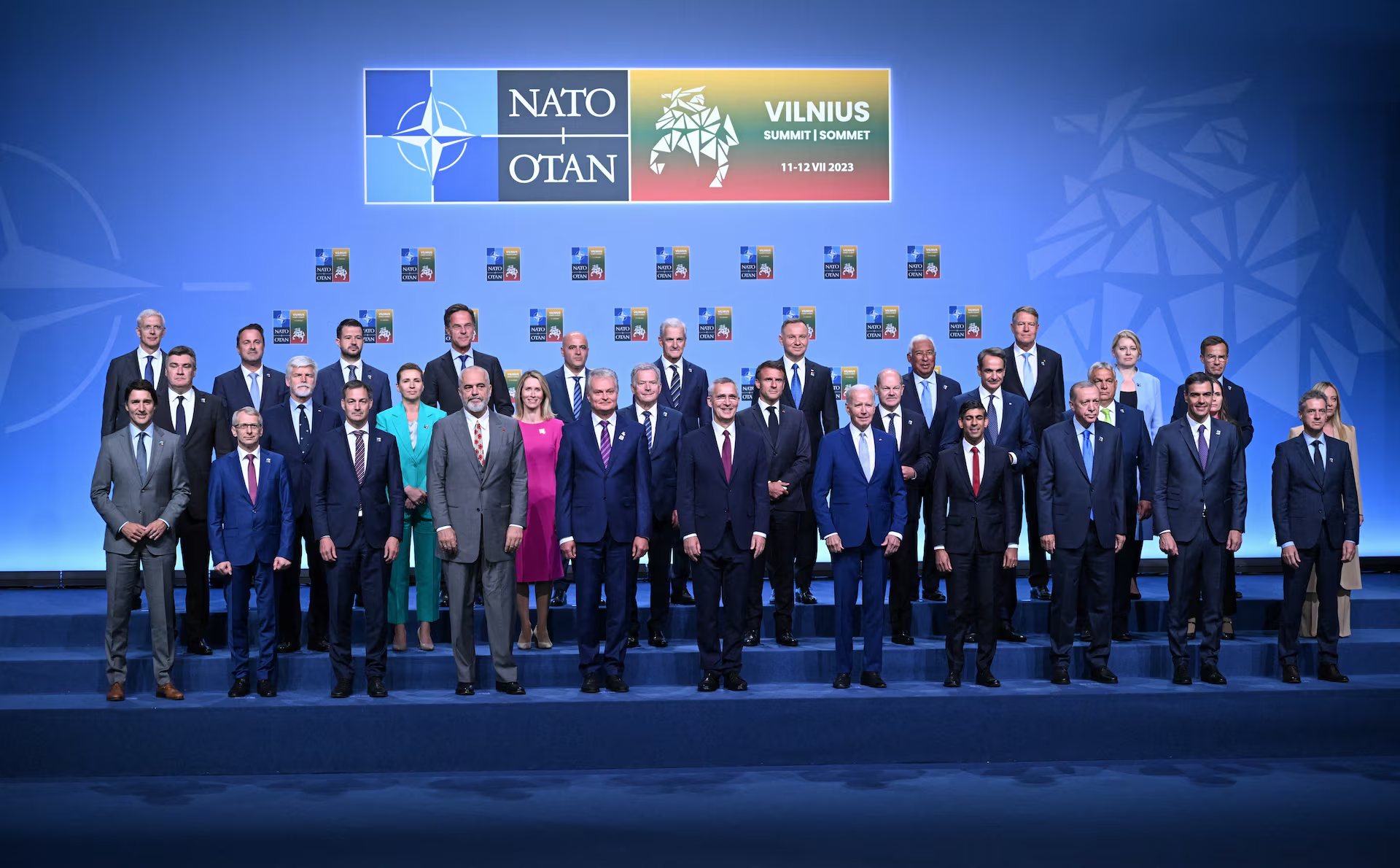
One of the most scrutinized aspects of Trump’s remarks concerned NATO. He reiterated his long-standing position that the alliance must ensure fairer distribution of defense spending responsibilities, warning that the United States should not be expected to shoulder a disproportionate share of costs indefinitely.
While Trump acknowledged NATO’s historical role, he emphasized that alliances must be “reciprocal” and “accountable.” The language echoed past criticisms that unsettled European capitals during his presidency and again raised questions about Washington’s long-term commitment to collective defense.
Several European officials in attendance responded cautiously, reaffirming their commitment to NATO while stressing that alliance cohesion depends on predictability and trust. Diplomats noted that many NATO members have increased defense spending in recent years, partly in response to earlier U.S. pressure, but cautioned that public criticism risks undermining unity at a delicate moment.
European Reaction: Concern and Caution
Reaction from European leaders was measured but unmistakably concerned. Officials from Germany, France, and smaller NATO member states emphasized that collective security cannot function as a transactional arrangement.
Behind the scenes, diplomats expressed unease that Trump’s rhetoric could embolden adversaries by suggesting uncertainty about allied responses in a crisis. Publicly, however, leaders avoided direct confrontation, opting instead to reiterate shared values and mutual interests.
European media coverage framed the Davos remarks as a reminder of the divergent philosophies that have characterized transatlantic relations in recent years, particularly regarding multilateralism and global governance.
Immigration as a Global Issue
Immigration featured prominently in Trump’s briefing, extending beyond domestic U.S. politics into a broader critique of international migration management. Trump argued that uncontrolled migration places strain on social services, undermines national sovereignty, and fuels political instability.
He urged European governments to adopt stricter border controls and framed immigration enforcement as a prerequisite for economic security. The comments resonated with some leaders facing domestic pressure over migration, while others pushed back, arguing that migration requires coordinated international solutions rather than unilateral restrictions.
Humanitarian organizations attending Davos expressed concern that such rhetoric risks oversimplifying complex drivers of migration, including conflict, climate change, and economic inequality.
Business Leaders Weigh the Implications
Davos is as much an economic forum as a political one, and Trump’s remarks prompted questions from business leaders about predictability and market stability. Executives from multinational companies stressed that global supply chains and investment decisions depend on stable diplomatic relationships and clear policy signals.
Some corporate leaders welcomed Trump’s emphasis on national economic interests, arguing that governments must prioritize domestic growth and competitiveness. Others cautioned that escalating tensions with allies could disrupt trade and complicate regulatory cooperation.
The mixed response underscored a broader divide within the business community over how closely economic globalization should be tied to national policy priorities.
U.S. Domestic Politics on Display
Observers noted that Trump’s Davos briefing appeared calibrated not only for an international audience but also for voters at home. By emphasizing border security, alliance costs, and national sovereignty, Trump reinforced themes that have long resonated with his political base.
Analysts suggested that the speech functioned as a preview of how foreign policy could be framed in future campaigns: less as a cooperative endeavor and more as an extension of domestic economic and cultural concerns.
This blending of domestic and foreign policy messaging has become a defining feature of contemporary U.S. politics, with significant implications for international partners.
Comparisons to Past Davos Addresses
Trump’s approach contrasted sharply with the tone adopted by previous U.S. presidents at Davos, who typically emphasized global cooperation, climate initiatives, and institutional leadership. Even when disagreements existed, they were often framed within a broader commitment to multilateral engagement.
Supporters argue that Trump’s bluntness reflects a necessary correction to what they view as unrealistic globalism. Critics counter that diplomacy requires nuance, particularly in public forums watched by allies and adversaries alike.
The contrast was not lost on attendees, many of whom described the briefing as one of the most politically charged Davos appearances in recent memory.
NATO’s Institutional Response
NATO officials sought to downplay the controversy, emphasizing the alliance’s resilience and adaptability. In statements following the briefing, representatives highlighted ongoing cooperation and reiterated that collective defense remains the cornerstone of transatlantic security.
Privately, however, analysts acknowledged that repeated questioning of alliance commitments can influence long-term planning. Defense ministries across Europe continue to monitor U.S. political discourse closely as they assess future procurement and strategic posture.
Global Media and Public Reaction
International media coverage was extensive, with headlines focusing on alliance tensions and immigration rhetoric. Opinion pieces ranged from praise for Trump’s “plain speaking” to warnings that his approach risks isolating the United States.
Public reaction varied widely by region. In parts of Europe grappling with migration pressures, some audiences found aspects of Trump’s message relatable. Elsewhere, particularly in countries that rely heavily on U.S. security guarantees, concern dominated the response.
Strategic Implications Going Forward
Foreign policy experts note that while speeches alone do not change policy, they shape expectations and perceptions. Trump’s Davos remarks reinforced the view that U.S. foreign policy could again pivot toward a more unilateral posture, prompting allies to consider contingency plans.
Some analysts argue that this could accelerate efforts toward greater European strategic autonomy. Others believe that institutional ties and shared interests will ultimately limit any dramatic shift.
What remains clear is that Trump’s words continue to carry significant weight internationally, even outside formal office.
A Familiar Debate, Renewed
The Davos briefing revived a familiar debate about the future of U.S. leadership in a multipolar world. Is global stability best served through strong multilateral institutions, or through assertive national policies that demand reciprocity?
Trump’s answer was unmistakable. For supporters, it was a refreshing assertion of sovereignty. For critics, it was a troubling signal at a time when cooperation is urgently needed.
As global leaders departed Davos, the speech lingered as one of the meeting’s most discussed moments — a reminder that U.S. political discourse remains deeply intertwined with international affairs.