Political developments across multiple continents are reshaping diplomatic relationships, domestic power structures, and global security calculations. From leadership changes in Eastern Europe to renewed tensions among Western allies, today’s international news underscores the interconnected nature of modern geopolitics and the challenges facing governments worldwide.
Below is a comprehensive roundup of the most consequential global political stories dominating headlines today.
Eastern Europe: Leadership Shifts and Political Uncertainty
In Bulgaria, political uncertainty continues following the Constitutional Court’s approval of President Rumen Radev’s resignation. The move has triggered speculation about early elections and renewed concerns over institutional stability in a country that has experienced repeated political deadlock over the past several years.
Observers in Brussels are watching closely, as Bulgaria’s internal turbulence has implications for European Union decision-making, particularly on issues such as judicial reform, energy policy, and regional security. Analysts warn that prolonged instability could delay reforms and weaken Sofia’s influence within EU institutions.
Elsewhere in Eastern Europe, governments remain focused on balancing domestic pressures with broader regional security concerns, particularly in light of ongoing geopolitical tensions along NATO’s eastern flank.
Western Allies: Transatlantic Strains Resurface
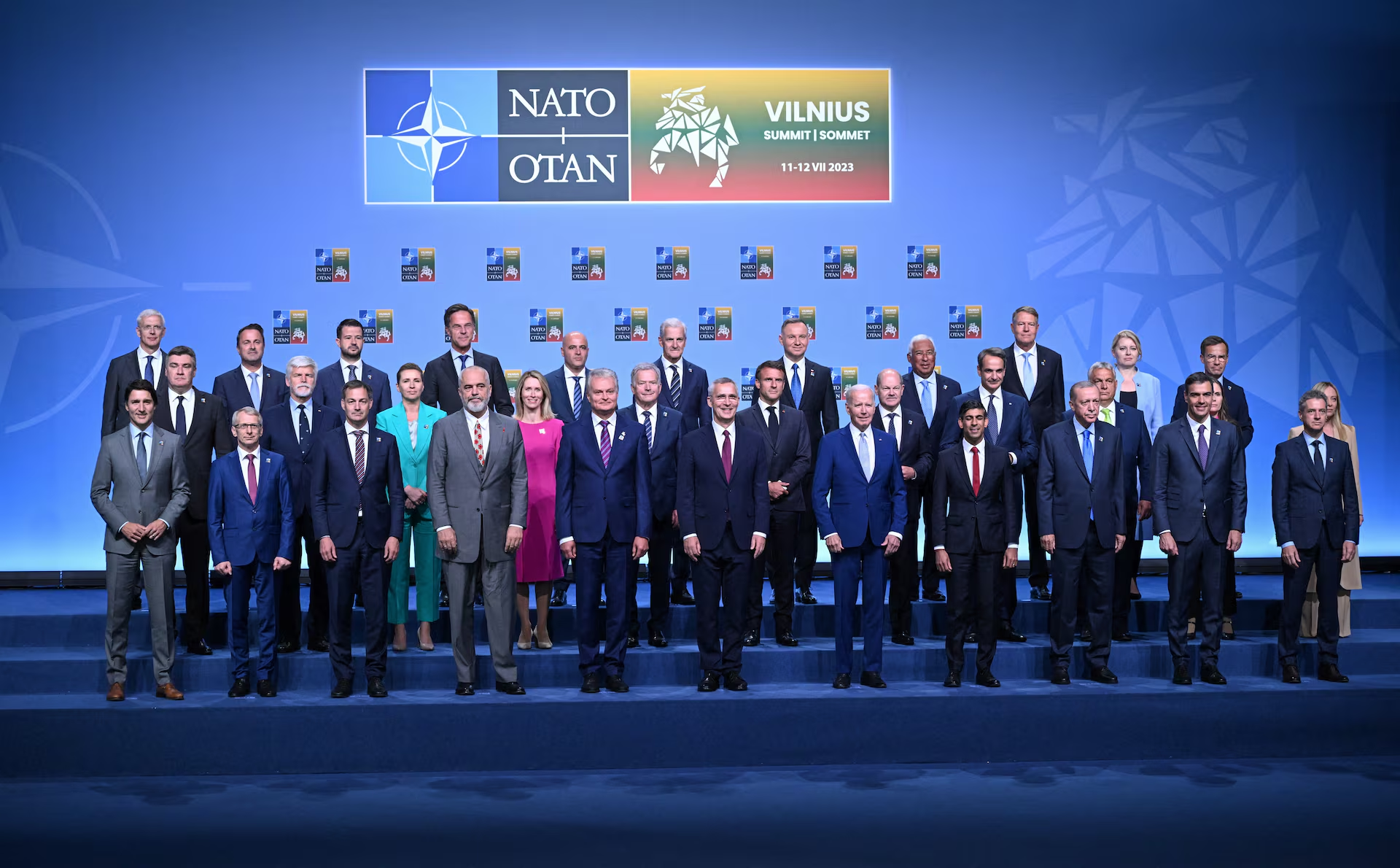
Relations among Western allies remain under scrutiny following renewed controversy over foreign-policy rhetoric from former U.S. president Donald Trump. Recent remarks questioning alliance commitments and burden-sharing have drawn pushback from key partners, including the United Kingdom and Canada.
British officials emphasized their country’s longstanding military contributions and reaffirmed commitment to NATO, while Canadian leaders rejected any suggestion that Ottawa has failed to meet its obligations. The episode has revived debates about alliance cohesion and predictability at a time of heightened global instability.
Diplomats stress that while formal policies remain unchanged, rhetoric alone can influence perceptions, planning, and trust among allies.
Europe: Immigration and Domestic Political Pressure
Immigration remains a dominant political issue across much of Europe. Several governments are facing internal pressure to tighten border controls and reform asylum systems as public concern grows over migration flows.
In Western Europe, centrist governments are increasingly squeezed between humanitarian obligations and voter demands for stricter enforcement. Far-right and populist parties continue to capitalize on these tensions, reshaping electoral landscapes in multiple countries.
European Union officials have reiterated the need for collective solutions, warning that unilateral measures risk undermining shared frameworks. However, national governments remain divided on how responsibilities should be distributed.
Middle East: Diplomacy Amid Ongoing Instability
In the Middle East, diplomatic activity continues against a backdrop of persistent conflict and fragile ceasefires. Regional leaders are engaged in talks aimed at de-escalation, while global powers maintain active involvement through mediation and security partnerships.
Political uncertainty in several countries has complicated negotiations over humanitarian access, reconstruction funding, and long-term governance. International organizations warn that without sustained diplomatic engagement, localized crises could escalate and spill across borders.
Energy politics also remain central, with oil-producing states navigating fluctuating markets and geopolitical pressure from both consuming nations and regional rivals.
Asia-Pacific: Strategic Competition and Domestic Challenges
Across the Asia-Pacific region, governments are balancing domestic priorities with intensifying strategic competition. In East Asia, security concerns remain closely tied to regional alliances and military posturing, while Southeast Asian nations continue to navigate relationships with major powers without undermining economic growth.
Several countries are also grappling with domestic political transitions, including leadership changes and upcoming elections that could influence regional alignment. Analysts note that even internal political shifts increasingly carry international consequences due to trade, technology, and security interdependence.
In South Asia, economic pressures and governance challenges dominate headlines, with governments under pressure to deliver growth while managing social and political divisions.
Africa: Elections, Security, and Economic Strain
African political news today reflects a mix of electoral developments, security concerns, and economic strain. In parts of West and Central Africa, governments continue to confront insurgencies and political instability, prompting regional and international responses.
Several countries are preparing for elections viewed as critical tests of democratic institutions. Observers emphasize the importance of transparent processes, particularly in nations with recent histories of disputed results or military intervention in politics.
Economic challenges — including inflation, debt, and climate-related pressures — remain central to political discourse across the continent, shaping policy choices and public sentiment.
Latin America: Governance and Social Tensions
In Latin America, political leaders face mounting pressure from voters frustrated by economic inequality, crime, and public service shortcomings. Protests and labor actions have re-emerged in several countries, highlighting persistent social tensions.
Governments are attempting to balance fiscal discipline with demands for expanded social programs, a challenge complicated by global economic uncertainty. Regional cooperation efforts continue, though ideological divisions among governments have limited collective action.
Analysts note that political developments in Latin America increasingly influence migration patterns, trade relationships, and diplomatic engagement with North America and Europe.
Global Economy and Political Risk
Political developments today are closely intertwined with economic concerns. Markets are reacting to signals from governments about fiscal policy, energy regulation, and trade relations.
Investors remain sensitive to political instability, particularly in countries facing leadership transitions or policy uncertainty. Central banks and finance ministries continue to coordinate responses to inflation and growth challenges, while political leaders navigate the social consequences of economic adjustment.
The intersection of politics and economics remains a defining feature of the current global landscape.
International Institutions Under Pressure
Global institutions such as the United Nations, NATO, and the European Union face renewed scrutiny as geopolitical divisions widen. Calls for reform are growing louder, particularly from countries that argue existing structures no longer reflect global realities.
At the same time, many governments acknowledge that multilateral cooperation remains essential for addressing challenges such as climate change, pandemics, and security threats. The tension between reform and continuity is shaping debates within international forums.
Looking Ahead: A Fragmented but Interconnected World
Today’s global political headlines reflect a world grappling with simultaneous challenges: leadership changes, alliance tensions, migration pressures, economic uncertainty, and security risks. While many of these issues are rooted in local contexts, their consequences are increasingly global.
For policymakers, the task is to manage immediate crises without losing sight of long-term stability. For citizens, the rapid pace of political change underscores the importance of informed engagement in democratic processes.
As events continue to unfold, one constant remains: decisions made in one part of the world now reverberate far beyond national borders, shaping the international order in real time.