In a dramatic culmination of a years-long international manhunt, Ryan James Wedding, a former Canadian Olympic snowboarder who U.S. authorities say transformed into one of North America’s most wanted drug traffickers, has been captured and brought into U.S. custody to face a raft of federal charges. The arrest, announced on January 23 and carried out in Mexico, has drawn global attention for its extraordinary arc — from Olympic competition to alleged leadership of a multinational cocaine trafficking empire and suspected involvement in multiple murders.
A Stunning Fall From Grace
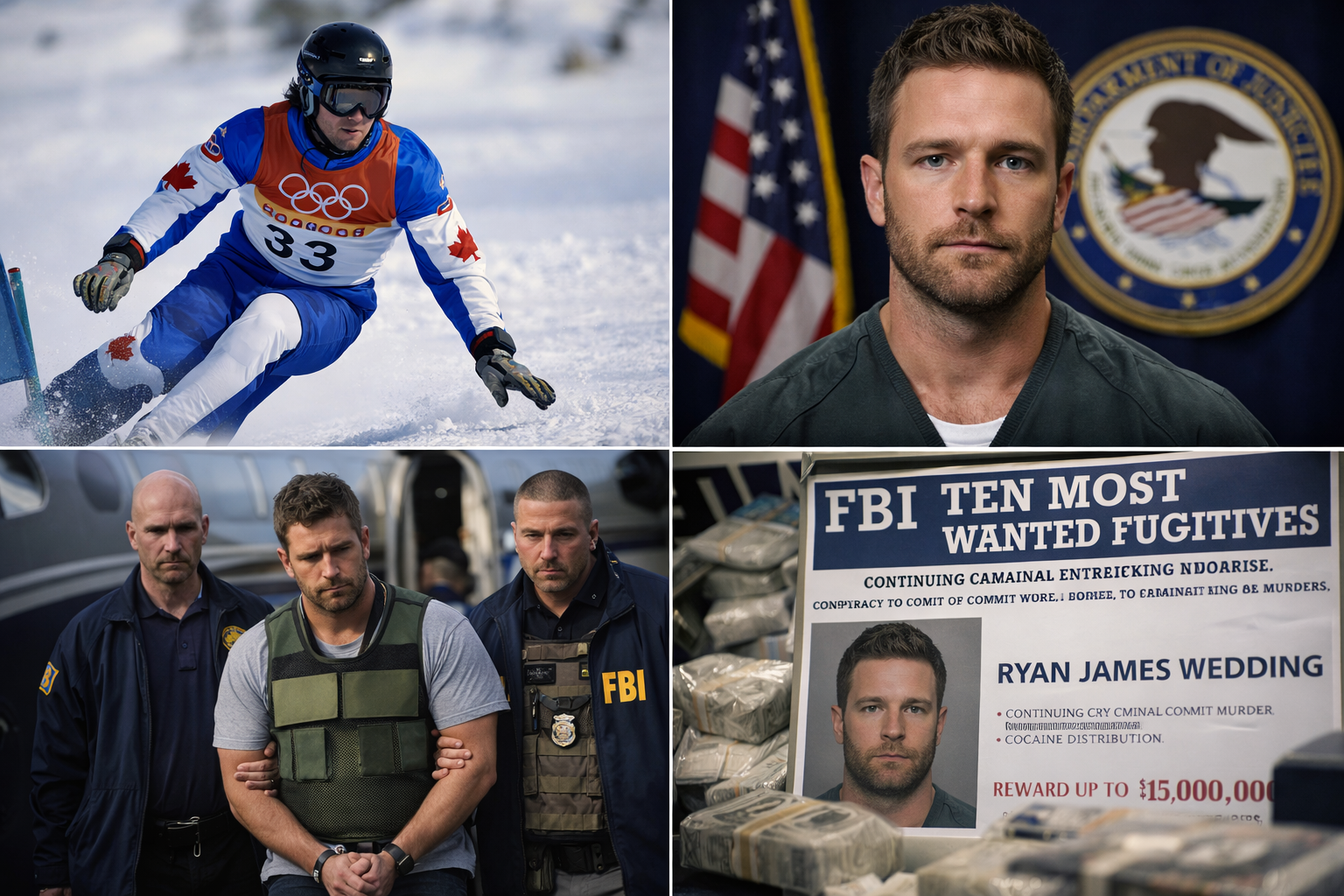
Ryan Wedding, born September 14, 1981, in Thunder Bay, Ontario, gained early recognition as a promising snowboarder. He represented Canada at the 2002 Winter Olympics in Salt Lake City, where he competed in the men’s parallel giant slalom event. Though not a medalist, his Olympic participation marked the peak of a once-bright athletic career.
What followed, according to U.S. federal authorities and prosecutors, was a remarkable — and sinister — transformation. Wedding allegedly abandoned competitive sports and gradually built a sprawling international criminal enterprise centered on cocaine trafficking, money laundering, and murder, operating across the United States, Canada, Mexico, and Colombia.
Criminal Enterprise Allegations
U.S. law enforcement officials have described the operation Wedding allegedly led as one of the most lucrative and dangerous drug trafficking networks in recent memory. According to prosecutors and investigators, Wedding’s organization moved huge quantities of cocaine — some estimates suggest as much as 60 metric tons annually — from Colombia through Mexico and into Southern California, ultimately funneling drugs into both the United States and Canada.
Authorities also claim that the network generated well over $1 billion in illegal revenue each year and had ties to Mexico’s notorious Sinaloa Cartel, one of the world’s most powerful drug trafficking organizations. FBI Director Kash Patel publicly likened Wedding to infamous figures such as Joaquin “El Chapo” Guzmán and Pablo Escobar, emphasizing the scale and brutality of the alleged enterprise.
In addition to drug trafficking charges, Wedding is accused of orchestrating multiple murders and attempted murders of rivals and potential witnesses. Prosecutors allege he ordered the killing of a key U.S. federal witness in Medellín, Colombia, in January 2025 before the witness could testify against him. Additional murders allegedly linked to Wedding include those of two people in Ontario, Canada, allegedly in response to a stolen drug shipment.
International Manhunt and FBI Most Wanted List
Wedding’s alleged criminal career drew increasing scrutiny from law enforcement over the past decade. In March 2025, the FBI added him to its “Ten Most Wanted Fugitives” list, highlighting the severity of the charges and the urgency of locating him. At that time, the U.S. Department of State’s Bureau of International Narcotics and Law Enforcement Affairs authorized a multi-million-dollar reward — reportedly up to $15 million — for information leading to his arrest and conviction.
The reward and designation underscored the importance of Wedding to U.S. efforts to dismantle transnational criminal networks. The FBI’s Most Wanted list, established in 1950, includes fugitives thought to pose grave risks to public safety, from drug lords to violent gang leaders. Wedding’s inclusion signaled that authorities believed him to be a particularly dangerous and elusive figure.
Capture in Mexico
The breakthrough came on January 22, 2026. Mexican authorities, working with U.S. law enforcement, took Wedding into custody in Mexico City, ending more than a decade of evasion. Officials have indicated that Wedding may have surrendered voluntarily at the U.S. Embassy in Mexico City, where he was subsequently arrested by FBI agents — a detail that suggests negotiation or strategic legal maneuvering may have played a role in bringing the fugitive to justice.
Shortly after his arrest, Wedding was transported back to California, where he was placed into federal custody. Federal prosecutors are preparing to formally arraign him on a range of serious charges, including continuing criminal enterprise, drug trafficking, murder in connection with a continuing criminal enterprise, money laundering, and witness tampering.
Comments from Law Enforcement
At a press event following the arrest, FBI Director Kash Patel declared the capture a major victory for law enforcement. He emphasized that Wedding’s alleged leadership of the narcotics network had “poured narcotics into the streets of North America,” causing widespread harm to communities and contributing to violence and addiction. Patel’s remarks drew comparisons between Wedding and historic drug cartel leaders, underscoring the perceived threat level of the fugitive.
Royal Canadian Mounted Police (RCMP) officials also praised the collaboration between Canadian, Mexican, and U.S. authorities, pointing to the arrest as a testament to international cooperation in combating organized crime. RCMP Commissioner Mike Duheme noted that Wedding’s activities had severely affected Canadian communities and that his arrest represented a significant blow to transnational drug trafficking networks.
Legal and Judicial Proceedings Ahead
Wedding is expected to make his initial court appearance in federal court in California, where prosecutors will outline the full scope of charges against him. Given the severity of the allegations — including murder and multi-ton drug trafficking — he faces potentially life-long imprisonment if convicted on all counts.
Legal experts suggest the prosecution will rely on extensive evidence gathered over years of investigation, including witness testimony, surveillance records, financial documentation, and international intelligence cooperation. The case is also likely to involve complex legal arguments around extradition, international jurisdiction, and coordination between countries that assisted in the arrest.
Broader Impact and Public Reaction
The arrest of a former Olympian turned alleged drug lord has captivated global audiences, partly because of the dramatic contrast between Wedding’s early athletic promise and the dark criminal legacy he is accused of forging. Media coverage around the world has highlighted not only the operational details of the drug trafficking network but also the sensational narrative of a public figure’s fall from grace.
In the United States and Canada, community leaders and law enforcement advocates have welcomed the arrest as a positive step in combating drug-related violence and distribution. The case also reignites discussion about the ongoing challenges posed by transnational crime, the reach of powerful cartels, and the effectiveness of international law enforcement cooperation.
Experts in criminal justice point out that while Wedding’s arrest removes a key figure from the criminal underworld, it does not, by itself, dismantle the networks that enable large-scale trafficking. They emphasize the need for continued intelligence sharing, targeted enforcement, and community-level support to address the complex social, economic, and legal aspects of the drug trade.
Conclusion
Ryan Wedding’s arrest marks the end of a dramatic chapter in the global fight against organized drug trafficking. From Olympic athlete to international fugitive, his story underscores how individuals can traverse drastically different paths — and how law enforcement agencies across borders can collaborate to bring even the most elusive criminals to justice.
With federal charges looming and an extensive legal process ahead, the case will likely remain in the public eye for months to come. Regardless of the outcome at trial, the capture of Wedding is being celebrated by officials as a significant triumph in the ongoing effort against transnational drug networks and violent crime.